
The Complete Performance Marketing Blueprint: From Clicks to Conversions (Beginner to Advanced Guide)
If you've ever run an ad, seen the clicks come in, and then wondered why your bank account stayed the same, this guide is for you.
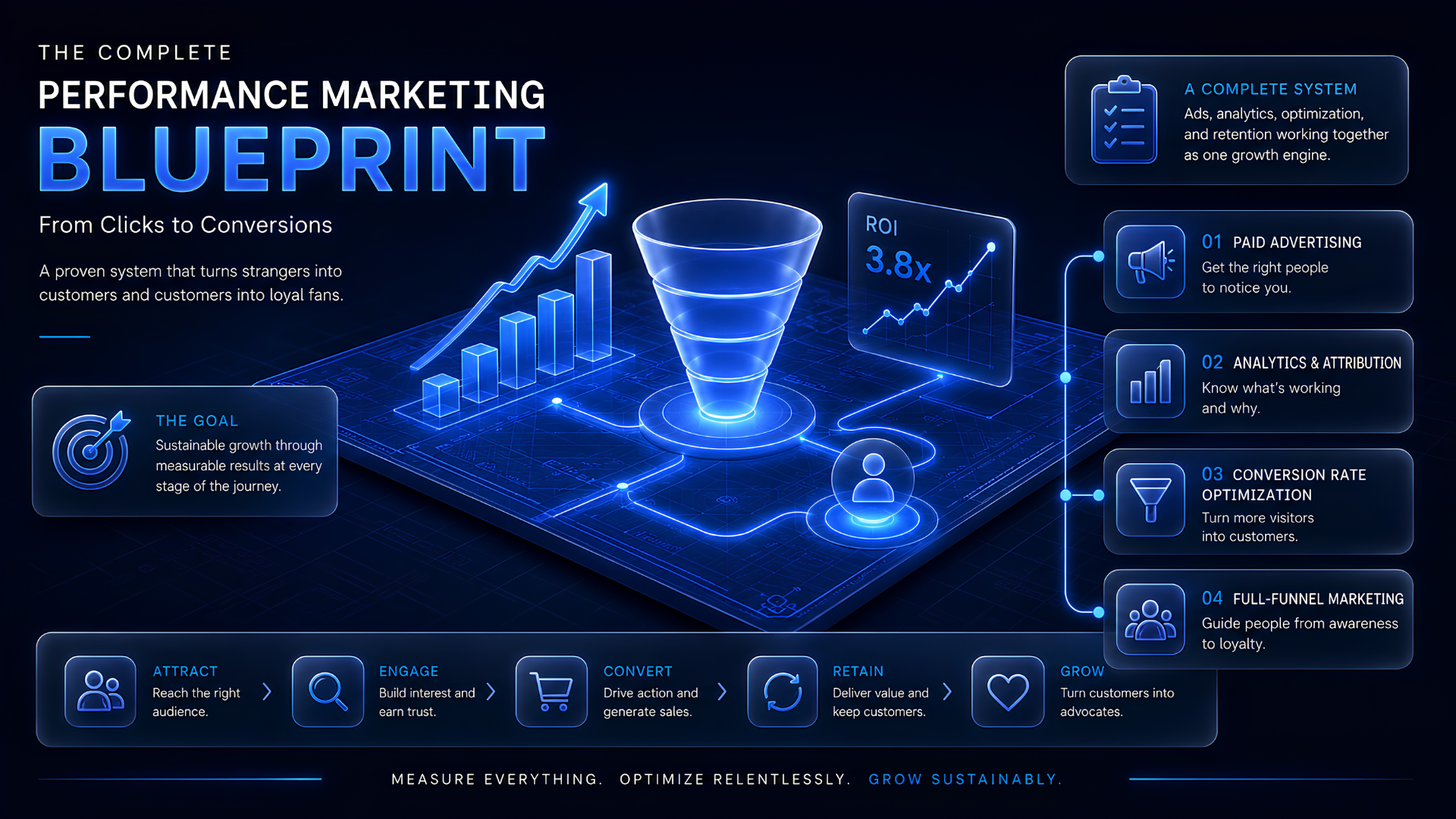
Most people think performance marketing just means running ads. But that's only one part of a much bigger process. Performance marketing is the whole system that turns a stranger scrolling Instagram into a paying customer, and then helps that customer come back again.
Think of it like a car. Paid ads are the engine. But an engine without wheels (analytics), a steering wheel (CRO), or a road map (funnel strategy) just burns fuel without going anywhere. This guide gives you the whole car: the blueprint I use with every client, whether they're a bootstrapped SaaS founder or a D2C brand making ₹50 lakh a month.
By the end, you'll see how the four pillars of performance marketing work together. You'll get a step-by-step framework to build your own plan, and you'll learn where most beginners make mistakes so you can avoid costly trial and error.
Table of Contents
What Is Performance Marketing?
The 4-Pillar Framework
The Performance Marketing Funnel, Explained Simply
Pillar 1: Paid Advertising - Choosing Your Channels
Pillar 2: Analytics & Attribution - Knowing What's Actually Working
Pillar 3: CRO – Why Traffic Alone Doesn't Pay the Bills
Pillar 4: Full-Funnel Marketing - Connecting Awareness to Loyalty
The Performance Marketing Blueprint: My Original 5-Step Framework
Benchmarks & Examples: SaaS vs. D2C Blueprints
A Worked Example: How the Blueprint Plays Out
How to Measure Success at Each Funnel Stage
Common Mistakes Beginners Make
Tools Checklist
Quick Glossary for Beginners
Continue Learning
Frequently Asked Questions (FAQs)
Conclusion
What Is Performance Marketing?
Performance marketing is a type of digital marketing where you only pay for measurable results like clicks, leads, or sales, instead of paying upfront for exposure as in traditional advertising.
Think of it like a billboard versus a vending machine. A billboard costs you money whether or not anyone sees it. A vending machine only takes your money when someone presses a button and gets a snack. Performance marketing works like the vending machine: you invest, and you can see exactly what your investment produced.
The key difference from traditional marketing is accountability. A TV ad or print campaign might build brand recognition, but if sales drop the next quarter, you can't really prove if the ad made a difference. Performance marketing removes that guesswork. Every rupee spent is linked to a click, a lead, or a purchase, and each action can be traced back to the specific campaign, ad, or even keyword that caused it.
But here's what most beginners miss: performance marketing is not just about the ad platform. It's the whole system around the ad, including the tracking that shows what worked, the landing page that convinces visitors to act, and the follow-up that turns a one-time buyer into a loyal customer. If someone only knows how to launch a Google Ads campaign but doesn't have tracking, an optimized landing page, or a retention plan, they're not really doing performance marketing. They're just buying traffic and hoping for the best.
That full system has four parts. Let's break them down.
The 4-Pillar Framework
Every performance marketing engine, no matter the industry, stands on four pillars. If you skip one, the whole system becomes unstable.
Pillar
What It Does
The Question It Answers
Paid Advertising
Gets the right people to notice you
"How do I reach my audience?"
Analytics & Attribution
Tells you what's actually working
"What's actually working?"
Conversion Rate Optimization (CRO)
Turns visitors into customers
"Why aren't people buying?"
Full-Funnel Marketing
Connects awareness to loyalty
"What happens after the click?"
Most beginners focus only on the first pillar and ignore the other three. That's why so many ad accounts 'don't work,' even if the targeting is fine. A great ad that sends traffic to a broken landing page with no tracking is like filling a bucket full of holes. You can keep pouring in more ad budget, but the bucket will never fill up.
I've reviewed accounts where the ads were genuinely excellent, with sharp targeting, strong creative, and a good cost-per-click, but the business was still losing money on every sale because nobody had checked the checkout page in eight months. The solution wasn't a better ad. It was fixing pillar three while leaving pillar one unchanged.
The Performance Marketing Funnel, Explained Simply
Picture a funnel in your kitchen - wide at the top, narrow at the bottom. Marketing works the same way.
- TOFU (Top of Funnel) - Awareness: Strangers discovering you exist. They don't trust you yet. They're not ready to buy.
- MOFU (Middle of Funnel) - Consideration: People who know you exist and are comparing you to alternatives.
- BOFU (Bottom of Funnel) - Conversion: People who are ready to buy and just need the final nudge.
Here's a mistake almost every founder makes: they run BOFU-style ads ("Buy Now! 20% Off!") to a TOFU audience who has never heard of them. That's like proposing marriage on a first date. It doesn't matter how good the ring is if the timing is wrong.
The performance marketing blueprint has content and ads mapped to each stage, not just the bottom. A stranger seeing your brand for the first time needs a reason to pay attention - a useful piece of content, an interesting hook, a problem they recognize.
Someone who's already engaged with you twice needs proof - testimonials, comparisons, case studies. Someone who's added a product to cart and left needs a nudge - a reminder, an incentive, or simply a well-timed retargeting ad. Three completely different messages, three completely different funnel stages, and yet most small businesses run exactly one ad, with exactly one message, to everyone.
Pillar 1: Paid Advertising - Choosing Your Channels
Not every platform deserves your budget. Here's how to think about the major ones:
- Google Ads: Best for capturing existing demand. If people are already searching for what you sell, Google Search Ads puts you in front of them at the exact moment they are interested. This is as close as marketing gets to selling to someone who's already raising their hand.
- Meta Ads (Facebook & Instagram) - Best for creating demand. Great for visual products, D2C brands, and interrupting the scroll with something people didn't know they wanted yet. Meta is a discovery channel, not a search-and-find channel - treat it that way.
- LinkedIn Ads: Best for B2B and high-ticket offers where you target job titles rather than just interests. The cost per click is usually higher than Meta, but you get a more qualified audience if your buyer is a company decision-maker.
- Microsoft Ads (Bing) - This is an underused, more affordable alternative to Google Search. It's especially effective for older or higher-income audiences, and for businesses whose competitors aren't advertising there yet. If you sell on marketplaces; these capture people already in a buying mindset on the platform itself, which usually means a shorter path to purchase than off-platform channel.
The rule of thumb is to start with one platform that matches your buyer's intent, prove it works, and then expand. Spreading a small budget across five platforms from the start is the quickest way to learn nothing. Each platform needs enough budget and time to get out of its learning phase, and splitting ₹20,000 five ways means none of them will reach that point.
Pillar 2: Analytics & Attribution - Knowing What's Actually Working
Here's an uncomfortable truth: most businesses make big ad decisions based on numbers they don't really trust, or even worse, numbers that are just wrong because of broken tracking.
- GA4 (Google Analytics 4) is your source of truth for what visitors do on your website after the click - how long they stayed, what they clicked, whether they converted.
- GTM (Google Tag Manager) is the control panel that lets you track specific actions (form fills, purchases, signups) without a developer editing code every time you want to measure something new.
- Looker Studio turns all that raw data into a dashboard you can actually read at a glance, instead of digging through five different ad platform logins every Monday morning.
Attribution is simply the question: "Which touchpoint gets credit for this sale?" For example, if someone sees your Instagram ad, googles your brand three days later, and then buys, was that a Meta conversion or a Google conversion? If you get attribution wrong, you might cut a channel that was actually working or scale one that wasn't.
This mistake probably causes more wasted ad budget than any targeting error, because it doesn't just cost you money once - it can steer every future decision in the wrong direction. Google Ads will happily take credit for a sale that Meta also influenced. That's not dishonesty - it's just how last-click and platform-siloed reporting works. Your job is to look at GA4 and blended numbers as the tiebreaker, not any single platform's dashboard in isolation.
Pillar 3: CRO – Why Traffic Alone Doesn't Pay the Bills
Imagine a shop with a line of interested customers outside, but the door is stuck, the price tags are missing, and there's no cashier. That's what a poorly optimized landing page does to your paid traffic.
Conversion Rate Optimization (CRO) is the practice of improving and increasing the percentage of visitors who take the action you want, like buying, signing up, or booking a call, without spending any extra money on admission rate, you've effectively halved your cost per customer. That's the same financial impact as cutting your ad costs in half - except it's permanent, and it doesn't stop working when you turn ads off.
A business generating 100 leads a month at a 2% landing page conversion rate that improves to 4% doesn't need to spend a single extra. That's why I tell every client the same thing: before you ask, "How do I get more traffic?" ask, "What happens to the traffic I already have?" Most of the time, the honest answer is that nobody has checked.t answer is that nobody's checked.
Pillar 4: Full-Funnel Marketing - Connecting Awareness to Loyalty
A first-time sale isn't the end. It's the start of a relationship.
Full-funnel marketing means designing intentional experiences for every stage:
- Awareness → introduce yourself with helpful, non-salesy content
- Consideration → nurture with proof, comparisons, and case studies
- Conversion → remove friction and make the "yes" easy
- Retention → keep customers engaged after they buy
- Loyalty → turn repeat customers into referral sources
Businesses that only market to the bottom of the funnel are always paying full price to get new customers. Businesses with a full funnel use early-stage marketing to support later sales, and let existing customers drive growth through retention and referrals, which is almost always cheaper than paid ads.
Think about the math: acquiring a new customer through paid ads might cost you ₹800. Getting an existing customer to buy again might cost you ₹80 through a well-timed email. Ignore retention, and you're voluntarily choosing the ten-times-more-expensive growth path, every single month.
The Performance Marketing Blueprint: My Original 5-Step Framework
This is the exact sequence I run with every client, from first conversation to live campaigns.
Step 1: Audit
Before you spend any money on ads, review what you already have: website tracking, past campaign data, competitor positioning, and your current conversion rate. You can't improve what you haven't measured, and you can't trust decisions based on broken data.
Step 2: Foundation
Set up GA4, GTM, and conversion tracking properly before launching ads. If you skip this step, you'll be flying blind for weeks while data quietly gets corrupted or lost. By the time you notice, you won't be able to recover it.
Step 3: Funnel Design
Map your specific TOFU, MOFU, and BOFU content and offers. What does a stranger see first? What convinces a considerer? What closes a ready buyer? Write this down explicitly - most businesses have never actually mapped it, they've just accumulated content and ads without a plan.
Step 4: Channel Selection
Choose one or two platforms that fit your buyer's intent and budget, not just the platform that's trending on social media this week. The right channel is where your specific buyer already pays attention and shows purchase intent.
Step 5: Optimization Loop
Launch, measure, and improve on a set schedule (weekly for ads, every two weeks for CRO tests, monthly for funnel reviews). Performance marketing isn't a 'set it and forget it' system. It's a loop that gets better the longer you run it, and the businesses that succeed over time are the ones that stick with the process, not those always chasing the next new tactic.
Benchmarks & Examples: SaaS vs. D2C Blueprints
The four pillars stay the same, but the blueprint looks different depending on your business model:
SaaS Blueprint Example:
- Paid Ads → LinkedIn + Google Search (high-intent keywords)
- Funnel → Free trial or demo as the mid-funnel offer
- CRO focus → signup flow and onboarding activation
- Full-funnel → email nurture from trial to paid conversion
- Typical benchmark → a healthy SaaS trial-to-paid conversion rate often falls between 15-25%, though this varies heavily by pricing tier and onboarding quality
D2C Ecommerce Blueprint Example:
- Paid Ads → Meta + Google Shopping
- Funnel → UGC and social proof at consideration stage
- CRO focus → checkout flow and cart abandonment
- Full-funnel → post-purchase flows to drive repeat purchase rate
- Typical benchmark → ecommerce landing page conversion rates commonly range from 1-3%, with strong performers pushing higher through CRO and trust signals
It's the same framework, but the execution is completely different. That's why copying someone else's ad strategy rarely works. Your blueprint needs to match your buyer's journey, not someone else's.
A Worked Example: How the Blueprint Plays Out
Take a hypothetical D2C skincare brand spending ₹1,00,000/month on Meta Ads with no tracking beyond the Meta Pixel, sending all traffic to the homepage.
Running the blueprint would look like this: The audit shows GA4 isn't even installed, so nobody actually knows the true conversion rate, and Meta is self-reporting numbers that can't be verified.
- Foundation step gets GA4 and server-side tracking (CAPI) set up, which immediately reveals that the reported ROAS was overstated.
- Funnel design shows there's no MOFU content at all - the brand goes straight from a cold ad to 'Buy Now,' with nothing in between to build trust for first-time visitors.
- Channel selection confirms Meta is still the right channel, but the budget is restructured to support both awareness content and a dedicated retargeting pool.
- Optimization loop starts with the highest-impact fix: replacing the homepage destination with a dedicated, message-matched landing page, which alone often leads to a meaningful increase in conversion rate before any ad creative changes.
In this example, nothing about the ad platform changed. The improvement came entirely from fixing pillars two, three, and four around it.
How to Measure Success at Each Funnel Stage
A blueprint is only useful if you know whether it's working. Here's what to actually track at each stage:
- Awareness (TOFU): reach, impressions, video view rate, cost per thousand impressions (CPM) - these tell you if you're getting in front of the right people affordably.
- Consideration (MOFU): click-through rate, time on site, content engagement, email open/click rate - these tell you if your message is landing once you have attention.
- Conversion (BOFU): conversion rate, cost per acquisition (CPA), return on ad spend (ROAS) - these tell you if the funnel actually closes the sale.
- Retention: repeat purchase rate, churn rate, customer lifetime value (LTV) - these tell you if the relationship survives past the first transaction.
Most businesses only look at the numbers from the conversion stage. That's like judging a relationship only by the first date and never seeing if the person calls back.
Common Mistakes Beginners Make
Running ads before tracking is set up means you'll be optimizing based on guesses, and every early decision you make will be built on shaky ground.
Sending all traffic to the homepage instead of a dedicated landing page that matches the ad's message and speaks directly to what was promised.
Judging campaigns too early is a mistake. Most ad platforms need a learning period before performance stabilizes, and stopping a campaign on day three tells you almost nothing
Ignoring the middle of the funnel by jumping straight from 'stranger' to 'buy now' and then wondering why conversion rates stay low.
Chasing platform-reported ROAS without checking it against GA4 or your actual revenue in the bank.
Tools Checklist
- Google Analytics 4 (GA4) - your website behavior source of truth
- Google Tag Manager (GTM) - for tracking events without touching code every time
- Looker Studio - for turning raw data into a dashboard you'll actually check
- One primary ad platform (Google Ads, Meta Ads, or LinkedIn) - chosen to match buyer intent
- A dedicated landing page builder or CMS - so ads never point to a generic homepage
- A/B testing or heatmap tool - once you have sufficient traffic to draw reliable conclusions
- Email/CRM tool - for nurture and retention flows that keep customers past the first sale
Quick Glossary for Beginners
- CPA (Cost Per Acquisition): how much you spend, on average, to get one customer or lead.
- ROAS (Return on Ad Spend): revenue generated for every rupee spent on ads.
- CTR (Click-Through Rate): the percentage of people who see your ad and actually click it.
- LTV (Lifetime Value): the total revenue a customer generates across their entire relationship with you, not just their first purchase.
- Attribution Window: the time period during which a click or view is still allowed to be credited for a conversion.
Continue Learning
If you're building a complete paid acquisition system, these guides will help:
- The Complete LinkedIn Ads Blueprint
- The Complete Google Ads Blueprint
- The Complete Meta Ads Blueprint
- The Complete Amazon Ads Blueprint
Frequently Asked Questions (FAQs)
1. How much budget do I need to start performance marketing?
There's no universal number - it depends on your industry's cost per click and your conversion rate. Start with an amount you can afford to spend for at least 4–6 weeks while you gather data, rather than a one-week test that ends before the algorithm has learned anything.
2. How long until I see results?
Expect a learning phase of 2–4 weeks on most ad platforms before performance stabilizes. Full-funnel results (retention, referrals) typically take 2–3 months to show up meaningfully.
3. Do I need all four pillars from day one?
No - but you need awareness of all four. Start with tracking (Pillar 2) and one paid channel (Pillar 1), then layer in CRO and full-funnel work as budget and traffic grow.
4. What's the biggest ROI lever for a small budget?
Usually CRO. Improving your landing page conversion rate is often cheaper and faster than trying to out-bid competitors for more traffic.
5. What's the difference between performance marketing and digital marketing?
Digital marketing is the umbrella term for all online marketing, including branding and organic content that isn't directly measurable. Performance marketing is the specific subset built around trackable, ROI-driven actions.
6. Can I run performance marketing myself, or do I need an agency?
Early-stage founders can absolutely run it themselves if they invest in learning tracking fundamentals first. Most businesses bring in outside help once they're managing multiple channels at once and the cost of trial-and-error starts outweighing the cost of expertise.
Conclusion
Performance marketing isn't about choosing the 'best'" ad platform or the latest growth hack. It's about building a system of - traffic, tracking, conversion, and retention - that grows stronger over time.
This blueprint is the foundation for everything else on this blog. Every guide in the Paid Advertising, Analytics & Attribution, CRO, and Full-Funnel hubs builds on the framework you just read.
If you'd rather have this built for your business than build it yourself, that's exactly what I do.
Want to Build a Similarly
Powerful Growth System?
Apply for a 20-minute growth audit where we'll dissect your current funnels and identify exactly where you're leaving revenue on the table.